
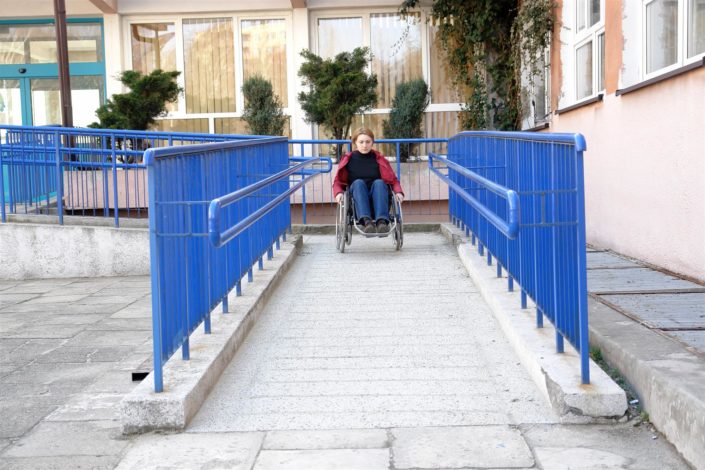
For far too long, the challenge of accessibility has been viewed as a rigid, often uninspiring, set of regulations. The vision of a clunky, utilitarian ramp sprawling across a sidewalk or intruding on a beautiful facade has often led to a stalemate between compliance and aesthetics, particularly in urban environments or historic buildings where space is at a premium. Yet, a new era is dawning, one where innovation meets regulation with grace and ingenuity. Creative solutions are now transforming the implementation of compliant ADA ramp slope in tight spaces, proving that accessibility can be both a legal requirement and an elegant, seamless addition to any architectural design.
The core problem stems from a fundamental conflict: the necessity of a specific gradient for a ramp to be usable and the reality of limited physical space. The normal requirements have a gentle slope that is usually a 1:12 gradient and this implies that 1 inch of vertical elevation has to include 12 inches of running horizontal a ramp. This simple rule can make a compliant ramp for even a modest set of stairs an architectural challenge, particularly in densely packed urban settings where every square foot is valuable.
The Paradigm Shift: From Obstacle to Opportunity
The first step in this creative revolution is a mental one—shifting the perspective from viewing the ramp as an obstacle to seeing it as an opportunity for innovative design. Instead of simply bolting on a standard ramp, architects and designers are now asking: how can we integrate this feature in a way that enhances the building’s function and aesthetic?
This paradigm shift has led to a focus on multi-functional design. What if it’s also a part of the landscape architecture, a sculptural element, or a clever use of space that serves more than one purpose? This approach moves beyond the minimum requirements, seeking to create a solution that adds value, not just solves a problem. It’s about building a better, more inclusive environment, not just checking a box.
The Vertical Solution: Lifts, Platform Elevators, and Smart Inclines
When horizontal space is non-existent, the solution must go vertical. While elevators are a common solution for multi-story buildings, creative applications of lifts and platform elevators are changing the game for single-level elevation changes.
These compact, often hydraulic or electric-powered lifts can be seamlessly integrated into a landing or a small entryway. When not in use, a platform can retract into the floor, leaving a flat surface. This solution is perfect for heritage buildings where a permanent ramp would alter the historical facade, or for commercial spaces where every inch of floor space is needed. For outdoor applications, more robust, weather-resistant platform lifts offer a clean, unobtrusive solution to navigate a single step or a small flight of stairs.
The Modular and the Temporary: Flexibility in a Fixed World
Not every accessibility need is permanent. For events, temporary spaces, or historic buildings where a permanent alteration is forbidden, modular and portable ramp systems are an indispensable creative solution. These systems, which can be quickly assembled and disassembled, offer a compliant solution for temporary access needs without the commitment of a permanent installation.
Modular ramps are made from lightweight yet durable materials like aluminum, and can be configured in a variety of shapes and lengths to fit the specific needs of a space. Their flexibility and ease of use are a game-changer for event organizers and facility managers who need to provide accessibility on demand. This approach proves that accessibility doesn’t always have to be a fixed, unyielding structure; it can be as flexible and dynamic as the spaces it serves.
Conclusion: Accessibility as an Act of Design
The challenge of implementing compliant ramps in tight spaces is no longer a design compromise but an opportunity for innovation. By embracing creative thinking, new technologies, and a holistic approach to design, architects, builders, and property owners are finding ways to meet accessibility regulations with elegance and ingenuity. From discreet platform lifts and sculptural zigzag ramps to the thoughtful use of materials and modular systems, the solutions are as diverse and dynamic as the spaces they serve.